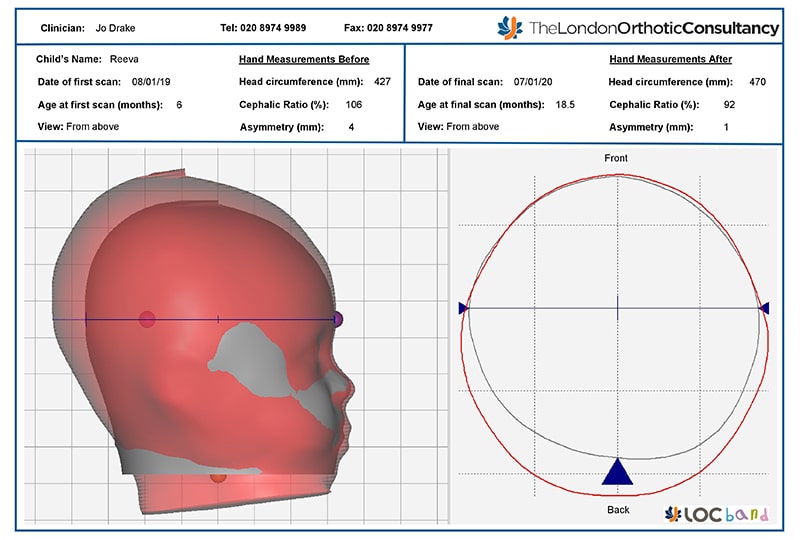
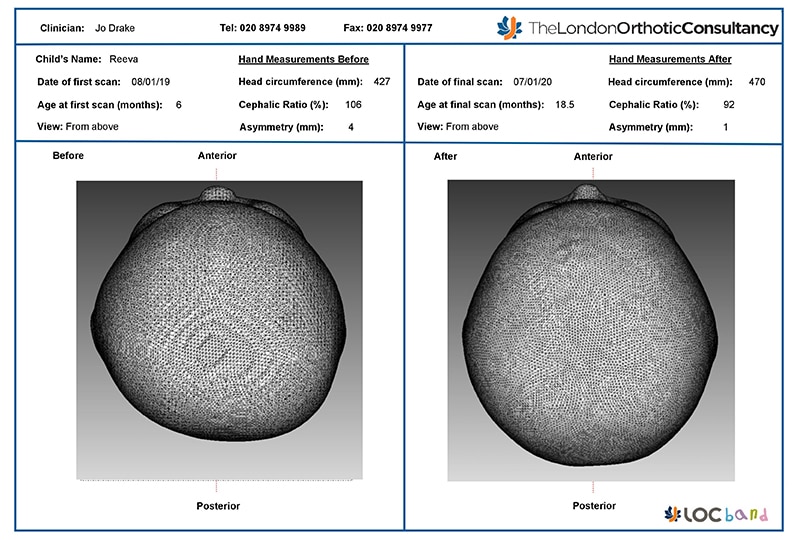
Like many parents who notice that their newborn’s head shape isn’t quite right, Olivia was in a quandary about what to do. Her daughter, Reeva, had been born by emergency Caesarean section following three days of labour in which she had been in the back-to-back position. As a consequence, Reeva’s head had been pushed out of shape. “It looked a bit cone-shaped,” says Olivia, “but I just assumed that was from where she’d got stuck during labour and didn’t think anything of it at first.”

However, as time went on, Olivia realised that Reeva’s head wasn’t settling back into a ‘normal’ shape. “I struggled to try to correct it myself with tummy time and pillows, but as she got bigger, it just kept getting more obvious that it was flat at the back and sloped up slightly from the forehead to the crown,” she says.

Although she was assured that Reeva did not have anything medically wrong with her, Olivia began to grow concerned about how her daughter’s head shape might adversely affect her in the future. Would she be able to wear a bicycle helmet, or have her hair tied back without feeling self-conscious? Would other children tease her?

Olivia had read about a condition called ‘flat head syndrome’ and began doing some internet research on possible treatments. It was then that she came across LOC. “It said on the website that you could send in pictures and that they would give you a free consultation if they thought you should come in,” says Olivia, who filled in the form and sent in photos straight away. “They emailed me back very quickly, offering to make an appointment for an assessment.”

Reeva was seen at our Kingston clinic by Orthotist Jo Drake, who took measurements of the little girl’s head and diagnosed her with brachycephaly, a condition where the rear of the skull appears flat. It occurs when there is a restriction to growth at the back of the head resulting in flatness and an increase in the width of the head to accommodate the growth of the brain. Although brachycephaly can be congenital (meaning it exists before birth), in Reeva’s case, its cause was more likely position-related, as a result of her complicated birth.

The optimal age for beginning treatment is between four and seven months when the skull is still soft and the cranial plates haven’t yet fused. Reeva was first scanned at six months, so there was no time to lose – especially as her case was very severe with a cephalic ratio of 106%.

“We consider 89% to be the top end of normal, with anything up to 94% classed as moderately severe,” explains Jo. “So, Reeva’s head was wider than it was deep, making it very noticeable visually.”

Reeva's scans before and after.

“Jo recommended fitting Reeva with one of our cranial remoulding helmets called the LOCband, which works by applying gentle, constant pressure over the areas of the baby’s skull that are most prominent while allowing unrestricted growth over the flattened areas. “We were in two minds at first,” says Olivia, who was worried about how Reeva would cope, both physically and emotionally, with wearing a helmet for 23 hours a day. “But, when we talked to Jo and weighed up the pros and cons, we decided to go ahead with the treatment. We knew it wasn’t going to improve by itself.”

Opting for treatment is a big decision for parents, says Jo, although improvements almost always occur quickly after the LOCband is fitted. “Once we get past fitting and the first review a week later, things start to feel a little more relaxed for the parents.”

Luckily, Reeva adjusted to her new helmet with ease. “She loved it,” says Olivia, who decorated Reeva’s helmet with stickers and feathers to make it more cheerful. “She called it her ‘hat’.”

Reeva began wearing her helmet in January 2019, making regular visits back to LOC for check-ups. She rapidly showed improvement at the start with her CR dropping 5% in the first 6 weeks.  After this, things slowed down, losing 1% here and there, which is normal at the age she had reached. Following Jo’s advice, Reeva’s parents decided to keep going with the treatment. By December 2019, Reeva’s head was showing signs of hardening, meaning the window for any further manipulation of her skull was closing in, so the decision was made to remove her helmet.

Her most recent scan, in January 2020, revealed that Reeva’s CR is now 92%, a marked decrease from her original reading. Although this figure is still above what is considered normal, Reeva’s appearance has dramatically improved, as shown in her cephalic ratio reducing from 106% to 92% afterwards. “I always like to try and correct the head shape into the normal range but, given the level of severity that Reeva started at, that was always going to be difficult,” says Jo. “By the end of treatment, she had a nice curve to the back of her head, and this will possibly improve a little further naturally in the next few years. Reeva has had a brilliant result.”

Related Video

Reeva's Transformation: Before and After Scans

Olivia agrees: “Jo was more than happy for us to finish the treatment there because it was as good as it was going to be visually. And we cared more about Reeva’s future confidence than the numbers.”

Olivia is delighted with the results and could not be happier with every step of the treatment process at LOC. “Right from the beginning, we got the answers that we were looking for and left the clinic knowing what we were going to do. Everything just felt really simple every time we went for an appointment,” says Olivia, adding: “I would definitely recommend LOC to other parents, and if anyone is in doubt about whether they should go for treatment, I’d say take advantage of the free consultation, because it was so worth it to go and get confirmation. I’m so happy I did it.”

Thinking about helmet therapy?

If you’re concerned about your baby’s head shape, get in touch today. You can complete our free flat head photo assessment form or contact us to arrange a free orthotic consultation with an orthotist.

How the LOCband Lite can help with plagiocephaly treatment

Backed by clinical research, LOCband Lite is a non-invasive cranial remoulding helmet designed to support a more balanced head shape over time. Results vary depending on age, severity and daily wear time.


“From the very start, everyone at the London Orthotic Consultancy was professional and friendly. Every step of the way was well-explained and the fitting was quick. It only took Magnus one day to get used to the band, and after that, he wasn’t bothered by it at all. And, most importantly, it worked!”

Maria, Magnus’s mother – Plagiocephaly patient

Get in touch for a free online orthotic consultation

Speak to our team about your options, with no obligation to begin treatment.

Not sure which appointment to book?

  • New patients: Please book an Assessment.
  • Existing patients: Please book a Review.

If you can’t find a suitable appointment, please contact us and our admin team will be happy to help.

020 8974 9989
  • We kindly ask for at least 48 business hours’ notice for cancellations or rescheduling. Cancellations made after this period may be subject to a fee. For full details, please refer to our Terms and Conditions.

  • Yes, if your previous orthotist offers online booking and has availability, you can choose to book with them again.


  • Please check your spam or junk folder first. If you still haven’t received a confirmation within 10 minutes, contact LOC Admin to confirm your booking via [email protected]


  • Yes. You can book on behalf of someone else. Please ensure the registration form includes the details of the person attending the appointment.


  • No account is required. Our booking process allows you to book as a guest. However, you will be asked to enter key details and complete required forms.


  • Most orthotic treatments are available online. If the treatment you’re looking for is not listed, please contact us directly and LOC Admin will assist you.


Get in touch for a free online orthotic consultation