



Speak to our team about your options, with no obligation to begin treatment.
If you can’t find a suitable appointment, please contact us and our admin team will be happy to help.
We use cookies where necessary to allow us to understand how people interact with our website and content, so that we can continue to improve our service.
We only ever receive anonymous information, and cannot track you across other websites.
View our privacy policyOrthotic devices play a crucial role in the rehabilitation of spinal cord injury (SCI) patients by providing support, stability, and improved mobility.

After initial treatment in an acute setting, many spinal cord injury patients may benefit from custom-made orthotics to support their recovery.
Since each patient’s needs vary significantly, a specialist assessment is essential to determine the most effective orthotic solution.
For some, orthotics can enhance mobility, while for others, they can improve posture or prevent muscle contractures, promoting overall function and quality of life. Depending on the severity and location of the injury, orthotics can help in the following ways:
Immediately following a spinal injury, PRAFOs (Pressure Relieving Ankle Foot Orthoses) are often used in hospital settings. These can:
Many spinal cord injury patients need ongoing orthotic treatment throughout their rehabilitation and beyond. As recovery progresses, different orthotic solutions may be prescribed to suit their changing needs.


Every spinal injury patient has unique needs. The best way to find out which orthosis is right for you is to book an appointment with one of our experienced clinicians. We can carry out a detailed assessment in our gait lab and work with you to achieve your personalised treatment goals.
Below, you’ll find more information about some of the more common types of orthotics we prescribe.
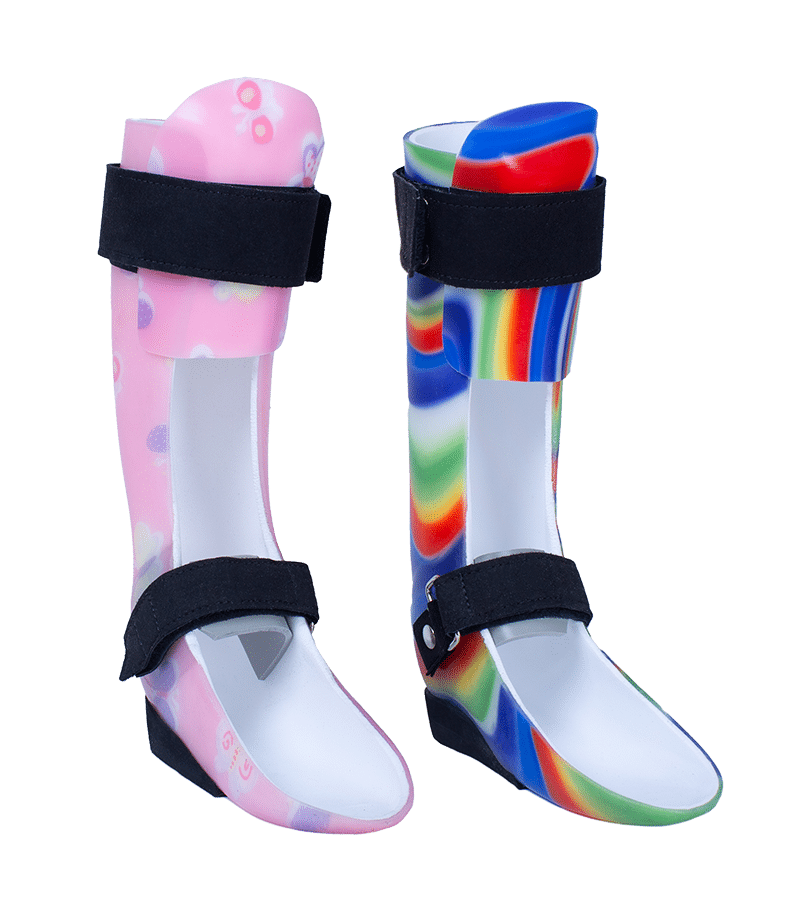
An Ankle Foot Orthosis (AFO) is a brace designed to support and control the position and movement of the ankle and foot. AFOs can also immobilise the ankle and lower leg to aid in rehabilitation and correct specific issues. They are the most well-known and frequently prescribed orthotic devices due to their versatility and effectiveness.
What sets our AFOs apart is the level of precision and customisation we bring to their design and tuning. Each orthosis we make is 100% bespoke. Depending on the patient’s needs, we can create AFOs with a fixed ankle for greater control of gait mechanics or incorporate a hinged design to allow controlled movement in a single plane.
A critical part of our process is the fine-tuning of each bespoke orthotic to ensure optimal alignment and comfort. We use state-of-the-art gait analysis technology as standard to help us assess, prescribe and fine-tune all our orthotics.
By prioritising this approach, we deliver AFOs that not only meet, but exceed, expectations for functionality and comfort.

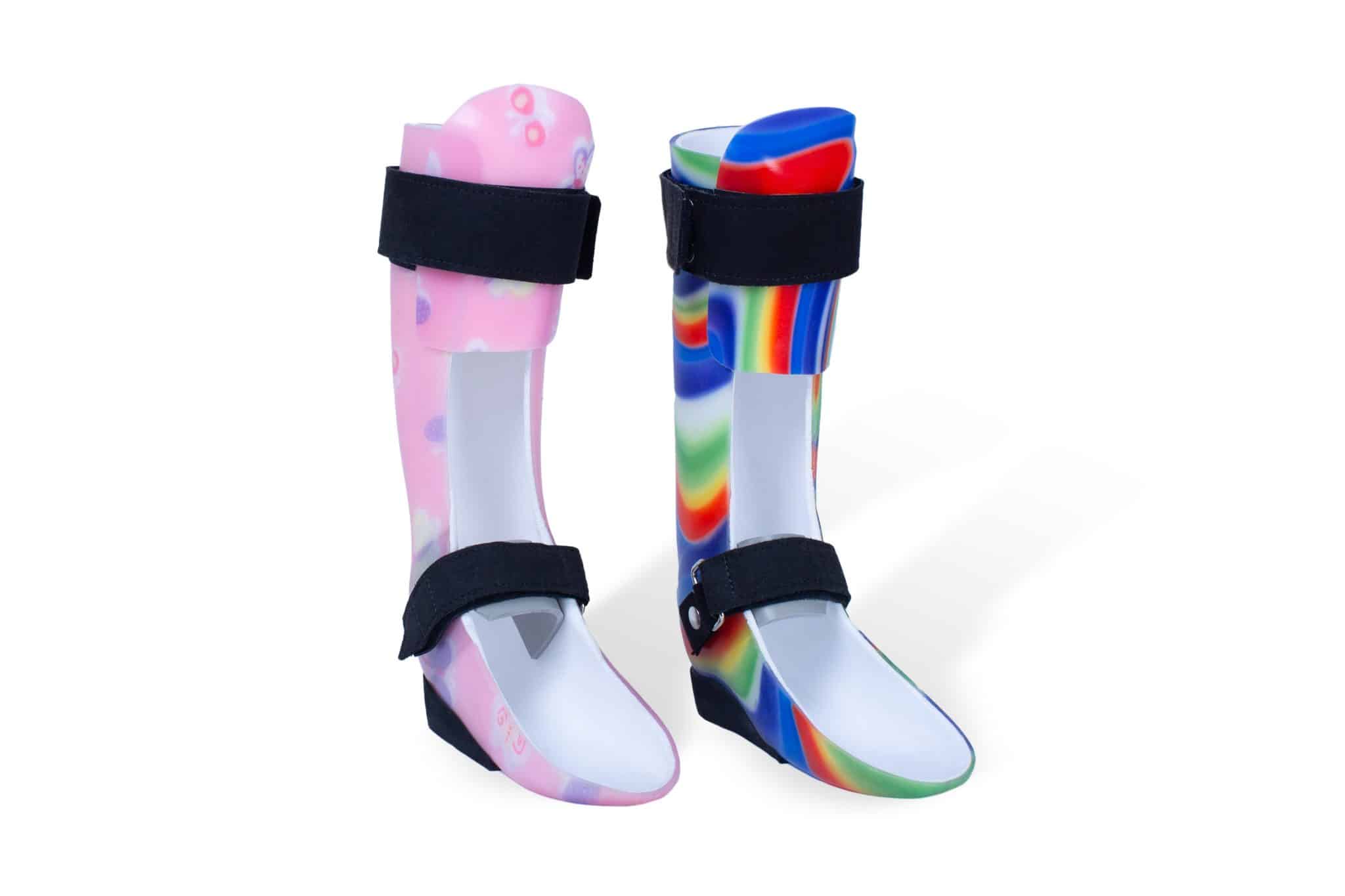
A Dynamic Ankle Foot Orthosis (DAFO) is a custom-made brace that supports the ankle and foot. Unlike rigid orthotics, a DAFO is thin and flexible enough to help with balance and stability while allowing the foot to move more freely.
It wraps around the patient’s entire foot to improve stability and gives excellent proprioceptive feedback from the ground using its dynamic footplate, so the brain is more aware of the position and movement of the foot.
This can be particularly beneficial for those with neurological disorders like cerebral palsy and spina bifida.

A Knee Ankle Foot Orthosis (KAFO) is a custom-made brace that supports the entire leg, spanning the knee, ankle, and foot. KAFOs are primarily prescribed for individuals with muscle-weakening conditions or paralysis caused by conditions like post-polio syndrome, muscular dystrophy, multiple sclerosis, Acquired Brain Injury (ABI), stroke and spinal cord injury.
KAFOs help by:
Our bespoke KAFO service ensures every device is tailored to your specific needs and preferences, guided by our team’s expertise and the latest orthotic advancements.
We offer cutting-edge options that go beyond traditional fixed KAFOs with locking knee joints. While fixed systems provide stability, they can contribute to muscle atrophy, increased energy expenditure, and an unnatural gait.
To address these challenges, we provide modern, innovative solutions. For example, KAFOs that automatically lock and unlock at the appropriate points in the gait cycle, promoting a more natural and energy-efficient walk.
The Neuro HiTronic System Knee Joint KAFO is an advanced electro-hydraulic knee joint designed by Fior & Gentz for use in a Knee-Ankle-Foot Orthosis (KAFO). This state-of-the-art technology enhances stability and mobility by using movement sensors to detect lower leg motion, allowing automatic locking and unlocking of the knee joint.
By providing smooth transitions and dynamic adaptability, the Neuro HiTronic KAFO significantly improves mobility, safety, and quality of life for individuals with complex mobility challenges.

The Neuro Swing system is an adjustable, dynamic ankle joint system designed to improve gait, stability, and rehabilitation. We commonly integrate them into carbon fibre Ankle Foot Orthoses (AFOs).
Unlike traditional fixed AFOs, this system allows some natural movement if the patient retains some muscle activity. The system allows tweaks and adjustments for different ankle alignments, allowing us to optimise for comfort and individualise adjustments based on your specific needs.
All this allows a more natural gait pattern, protecting bones and joints from abnormal stress. Not only does this benefit your ability to walk in the short-term, it also protects the bones and joints and encourage your muscles to work correctly.

The Agilik™ smart orthosis from Bionic Power is a state-of-the-art lightweight device designed to enhance walking by working with the user’s natural movement. Unlike exoskeletons, which support a patient’s body and move for them, the Agilik™ provides dynamic assistance and resistance during walking. This helps users stand straighter, walk more easily, walk for longer and build strength.
The London Orthotic Consultancy has been appointed the paediatric specialist centre for the Agilik™ smart orthosis in the UK.

A Reciprocating Gait Orthosis (RGO) is designed to assist individuals in walking by supporting a natural, reciprocal gait pattern. This device typically features jointed metal frames, straps, and components that attach to the user’s legs and torso. Its main function is to mimic the natural walking motion by coordinating the movement of the legs. So when one leg moves forward, the other moves backward, allowing for a smoother, more efficient walking pattern.
RGOs are equipped with hinges at the hip and knee joints, enabling dynamic movement and coordination. A locking mechanism provides added stability during standing or resting phases. The user initiates movement through weight shifting or by using assistive devices, with the RGO converting this motion into a coordinated walking pattern.
We specialise in the design and manufacture of bespoke RGOs particularly for spinal injury patients. Enhancing mobility and promoting greater independence in walking.
Speak to our team about your options, with no obligation to begin treatment.
If you can’t find a suitable appointment, please contact us and our admin team will be happy to help.