Speak to our team about your options, with no obligation to begin treatment.
If you can’t find a suitable appointment, please contact us and our admin team will be happy to help.
We use cookies where necessary to allow us to understand how people interact with our website and content, so that we can continue to improve our service.
We only ever receive anonymous information, and cannot track you across other websites.
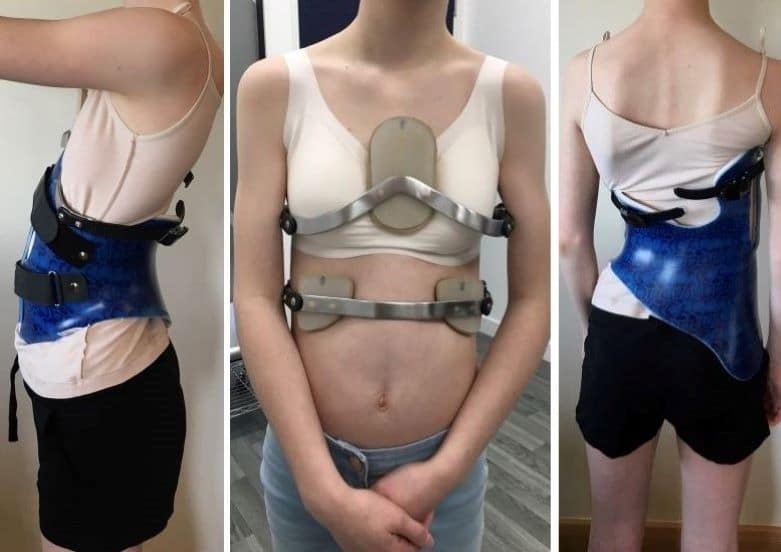
View our privacy policyFrom left to right: Daisy wearing her Cheneau-Gensingen scoliosis brace, Daisy wearing her pectus carinatum brace, and Daisy’s scoliosis brace viewed from behind.
“I’m an orthopaedic physiotherapist, so I recognised that something was not quite right and suspected that we might be looking at scoliosis,” she explains. “Our GP referred Daisy to a consultant at the hospital where I work. They X-rayed her and diagnosed mild scoliosis of nine degrees. They also confirmed that she had pectus carinatum but advised that, as they considered this a cosmetic issue, we should simply monitor it and take no further action at that time.”
By late 2019, Daisy was in year seven and aged 12. Both her scoliosis and pectus carinatum had become more noticeable, and Daisy had started to feel worried about how she looked.
“By that time, both scoliosis and the pectus looked more prominent and also displayed signs of rib flare. Plus, Daisy was starting to say that she worried about the way she looked,” Sara recalls. “So, at that point, I took her into LOC to see whether something could be done to help her. Sam (Sam Walmsley Founding Director at LOC) fitted her for a pectus chest brace in March 2020, after which a LOC Physiotherapist taught Daisy an exercise regime to help with the pectus deformity, but she was also interested in looking more closely at her scoliosis.”
“At the age of 10, I was diagnosed with mild scoliosis after concerns about my back. I was originally being seen by the NHS and monitored for about 3 years every six months. My scoliosis was slowly progressing but nothing too drastic and my NHS orthopaedic consultant told me that I would likely need bracing but not surgery. One night in winter 2019 my mum asked me whether I wanted to have my pectus carinatum sorted as I had been noticing it and feeling insecure about it for a while at this point. I said yes. I had previously seen a GP about it but they had said it was nothing to worry about; however, I was feeling particularly insecure about it.”
The London Orthotic Consultancy began by giving Daisy a home exercise programme. The aim was to support her pectus bracing treatment and monitor whether specific exercises could help prevent her scoliosis from worsening.
By May 2020, Sara was becoming more concerned. On LOC’s advice, she arranged an EOS scan in Harley Street. The scan showed that Daisy’s scoliosis had increased to between 20 and 22 degrees. This meant her spinal curve had more than doubled in six months.
“The pandemic meant that I couldn’t be treated on the NHS for my scoliosis so I had an EOS scan done at Harley Street and my scoliosis had almost doubled within 6 months bringing it to 22 degrees. This was still mild; however, it had a very high chance of progression so rather than wait to be treated on the NHS we opted for the Cheneau-Gensingen brace and physiotherapy at LOC.”
Further assessment at LOC showed that Daisy’s scoliosis had a 60% chance of progressing. Sara and Daisy decided it was time to start scoliosis bracing.
Because Daisy was already wearing a brace for pectus carinatum, she needed a bespoke solution that could treat both conditions at the same time.
“I had my brace fitted and I was also given a personalised exercise programme to help with my 3D rotation. Not only was I wearing this new brace but I still had my pectus brace on and the amazing orthotists managed to combine the two so they worked together. I really struggled with this at first; however, I kept going and now I’m really glad I did. My scoliosis overcorrected by 10 degrees and I was able to reduce my scoliosis brace wear to 16 hours a day within 6 weeks.”

LOC treats scoliosis with the LOC Scoliosis Brace, a bespoke brace designed to address the three-dimensional nature of a scoliosis curve. It can also help address associated rib flare.
For Daisy, LOC’s in-house manufacturing team created a bespoke bracing solution that allowed her to wear her pectus brace over her scoliosis brace, so both conditions could be treated together.
“Daisy initially wore the bracing for 22 hours a day,” says Sara. “Naturally, that was challenging for her. It’s not the most comfortable experience! But she persevered, as we knew it was important to undergo the treatment whilst her bones were still flexible. LOC offered fantastic support – they were always able to speak to us on Zoom or Skype if we needed advice and to see us in the clinic even during the pandemic. In particular, I was extremely impressed with the Covid-safe measures they have implemented. As a clinician working in a hospital myself, I felt they implemented exactly the protocols that I would expect in a medical environment. That was important to us – and I’m sure to all of LOC’s patients. When you are wearing an orthotic, there are always times when you are going to need to see your clinician face to face to deal with adjustments and that kind of thing. In my opinion, their care was the gold standard.”
“I really enjoyed going down to London and the orthotists were all really nice. There I had my pectus brace fitted and the adjustments made it more comfortable. Of course, I struggled with wearing that brace and it was uncomfortable at the start. However, I persevered and I eventually stopped noticing it was there and it just became part of my life.”
Daisy’s exercises played an important part in her treatment. Sara was impressed by the quality of the programme LOC designed, and by Daisy’s commitment to following it.
“Daisy picked up on the exercises very quickly. She’s very astute, she could feel when she wasn’t doing the movements quite right and corrected that very quickly. All of the exercises could be performed at home, using things we had lying around the house like a towel rail, so it was feasible to stick to the programme without having to buy lots of expensive equipment.”
By July 2020, Daisy’s follow-up scan showed a slight overcorrection of her scoliosis. This was an important milestone, as it meant LOC could begin to reduce how long she needed to wear her scoliosis brace each day.
“Daisy was so pleased,” says Sara,” because this meant that LOC could start to gradually reduce how long she needed to spend in her Cheneau-Gensingen brace each day. By the time she returned to school in September 2020, she didn’t have to wear the Cheneau-Gensingen brace during the day at all, but she still had to wear her pectus brace for 20 hours per day. At her most recent scan, her scoliosis was back down to 10 degrees, so LOC has completely corrected it. Daisy is much happier with the appearance of her chest as well – her carinatum was very one-sided, but now that asymmetry is hardly noticeable, and she only has to wear her pectus brace at night. The first consultant we saw estimated that she may have to wear a spinal brace until around the age of 18, which would have been at least another four years. But LOC has achieved outstanding results for my daughter in less than a year. This kind of bracing treatment is not easy, it takes perseverance. But the combination of Daisy’s perseverance and LOC’s outstanding care has given us results we could not be happier with.”
“By February 2021, I was out of my scoliosis brace and only wearing my pectus brace for 16 hours. Currently, I am wearing my pectus brace for 12-14 hours a day and I am very happy with the results of my treatment. I am very grateful to all the amazing people at LOC and I want to thank them for helping me so much. In the year and a half since my treatment started, I have come so far and I am incredibly happy with the results and I am incredibly happy that I persevered.”

The best time to start pectus bracing depends on several factors, including:
If your child has been diagnosed with scoliosis, pectus carinatum or both, contact us to arrange an initial consultation with one of our orthotic team.
A non-surgical orthotic option designed to support improvement in chest shape and appearance, with personalised treatment from experienced orthotists.

Speak to our team about your options, with no obligation to begin treatment.
If you can’t find a suitable appointment, please contact us and our admin team will be happy to help.
You can book a range of assessment and review appointments online, depending on the service and location that you require. If a specific appointment type is unavailable online, please contact LOC directly on [email protected] or you can call us. Unfortunately we are unable to offer fittings online at the moment.
Yes, if your previous orthotist offers online booking and has availability, you can choose to book with them again.
Please check your spam or junk folder first. If you still haven’t received a confirmation within 10 minutes, contact LOC Admin to confirm your booking via [email protected]
Yes. You can book on behalf of someone else. Please ensure the registration form includes the details of the person attending the appointment.
No account is required. Our booking process allows you to book as a guest. However, you will be asked to enter key details and complete required forms.
Most orthotic treatments are available online. If the treatment you’re looking for is not listed, please contact us directly and LOC Admin will assist you.