Due to the Microsoft outage, our email is down and some appointments may be affected. If you have a question about your appointment, treatment or anything else, please call us on 020 8974 9989.

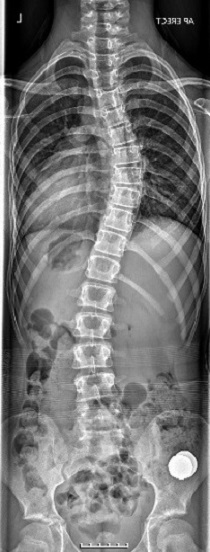
LOC first met 11-year-old Yasmin after she found out she had adolescent idiopathic scoliosis quite by chance; an X-ray taken for a chest complaint revealed she had abnormal twisting and curvature of the spine.

Scoliosis affects around three to four children in every 1,000 in the UK, most typically, between the ages of 10 of 15. Analysis of Yasmin’s X-ray revealed she had a Cobb angle – the metric for measuring the extent of the bend in the spine – in excess of 40֯, which meant she fell within NHS guidelines for requiring surgery.

She was immediately referred for treatment. However, her parents were keen to avoid painful spinal surgery with all the associated risks and lengthy recovery time. So, they contacted LOC in the hope of finding an alternative route.

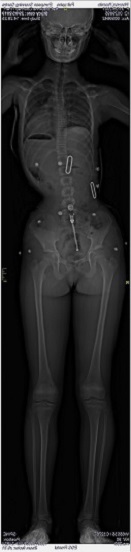
Above: Yasmin’s initial scans showed severe asymmetry

Severe asymmetry

Yasmin was examined at our Kingston clinic by LOC clinician Anna Courtney, who measured Yasmin’s trunk rotation with a scoliometer; this is a small non-invasive device that is placed over the spine while the patient is being measured is in a forward bending position. This showed that Yasmin had quite a large rotation, called a ‘rear hump’.

“There was a severe asymmetry in her shoulders that measured 21֯,” says Anna. “But she was very flexible and her parents wanted to proceed as quickly as they could in the hope of avoiding the need for surgery when she’s older.”

Bone growth is measured on a scale from zero to five and Yasmin’s was zero. Concerned that her scoliosis could rapidly decline if not treated straight away, Anna recommended that she be fitted for a brace and begin a course of physiotherapy. As skeletal maturity occurs between 14 and 17 years old in girls, Yasmin’s bones and spine were still malleable, making her an ideal candidate for bracing treatment, which can reduce both the curve and Cobb angle, and, crucially for Yasmin, the need for surgery in later life.

Corrective brace

As Yasmin’s Cobb angle was in excess of 25֯, she was scanned and photographed for a custom-made Cheneau-Gensingen brace, which treats scoliosis by immobilising the patient and guiding the body through a gentle corrective movement that realigns the spine and reduces distortions in posture. Alongside the brace, which she wears at all times except when showering and during sports activities, Yasmin has also started a comprehensive course of Schroth physiotherapy.

Anna has been particularly impressed by this young lady’s dedication to the programme: “Yasmin probably does about an hour-and-a-half to two hours of exercises a week in her own time, and then she comes to an hour-long group session here at LOC every fortnight,” she says.

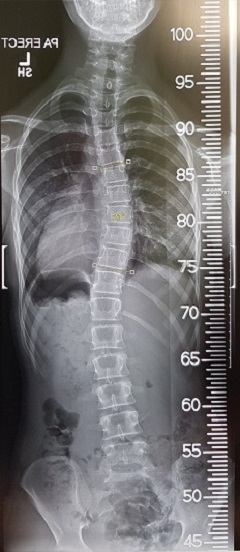
Above: This scan shows Yasmin’s position whilst wearing her brace

Excellent progress

That effort has made all the difference, with Yasmin making excellent progress in just six months. “She had grown in height by about 5cm, which helped the process, and her Cobb angle had reduced to 21֯,” says Anna. She goes on to explain: “In the bracing, we try to stimulate growth on the shorter side of the curve by offloading that side and almost overloading the wider side. This allows the shorter side to grow a little bit faster than the side that we’re compressing. So, that’s why we completely rely on growth to make that happen. It’s why bracing isn’t an option in adults, because the vertebrae have stopped growing and, as soon as a brace comes off, the spine falls back into its old shape.”

Both Yasmin and her parents are delighted with the improvement, especially as her NHS appointment has since come through and new X-rays have confirmed that she no longer requires surgery; instead, she will have twice-yearly monitoring. “Visually, you would not know she has scoliosis anymore,” says Anna. “And, she’s way away from surgical limits.”

Anna credits Yasmin’s diligence and determination with that success. “It really depends on the patient’s willingness to put in the time and effort with their treatment,” she says. “And, Yasmin has been exceptional for her age.”

But the hard work isn’t over yet. Ideally, Yasmin will wear the brace until she is skeletally mature (around 17) but, says Anna, “we will start reducing her hours in it as the curve comes down.”

In the meantime, Yasmin has been fitted for a new brace to accommodate her growth in height and improved spinal curve.

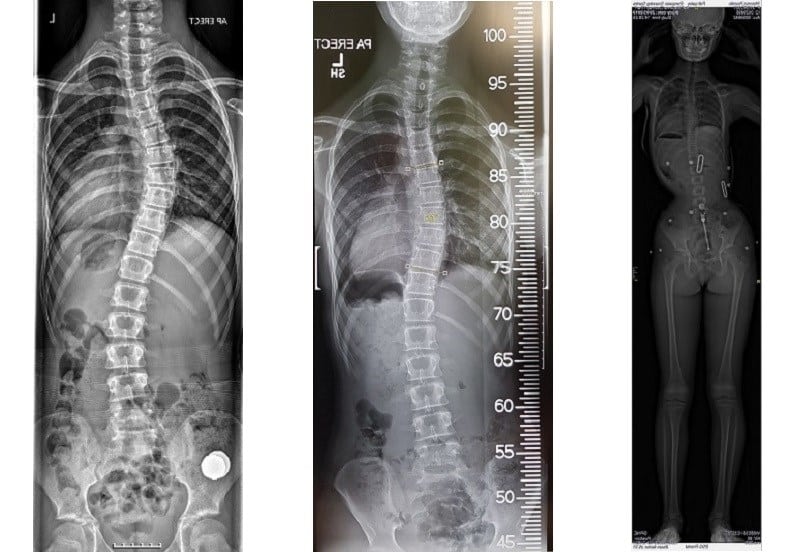
Above: This scan shows Yasmin’s position whilst out of her brace

Rapid treatment

They say timing is everything and that’s certainly been the case for Yasmin. By starting her treatment at the optimal age, she has been able to reap the long-term rewards, which Anna believes has been crucial to her rapid progress. “At LOC, we can fit a brace within two weeks of a consultation,” she says. “We’ve had patients who have been waiting for NHS appointments for six to eight months, and within that time, their curves have progressed considerably. We can act rapidly.”

Yasmin’s results speak for themselves and have certainly proved what can be achieved with the right treatment and a positive mindset. Her improved posture has boosted her self-confidence and with the motivation, she has shown already, we have no doubt she will continue to make excellent progress.

Share your story and find out more about LOC by following the LOC Facebook page, or our new Scoliosis Clinic page on Facebook. Alternatively, if you would like to talk to us about our scoliosis treatment packages, contact the LOC team here.

Related Video

  • The operation used to treat severe scoliosis curves is typically spinal fusion surgery; a major procedure that involves moving muscles and realigning the skeleton into place. The curved, deformed vertebrae are fused together into a single bone, putting metal screws and rods into the spine to help straighten it. Surgery typically lasts between 4 and 8 hours depending on the severity of the curve. Bone graft is then taken from other parts of the body and used to cover the implants.

  • Following the operation, it is necessary to spend around a week in intensive care before returning home and the first few days are often uncomfortable. Most adolescents can expect to return to school from 2-4 weeks following surgery, but pain medication may be required up to 6 weeks following. A full recovery from the procedure can take up to a year, as it can take that long for the spine to heal fully. Spinal fusion surgery causes the fused portion of the back to become permanently stiff, as a result, returning to sports that require large amounts of flexibility (ballet, yoga, gymnastics, dance) or contact (rugby, football, karate, hockey) may take longer.

  • Risks of spinal fusion surgery are like that of any other major procedure and include infection, blood clots and anaesthesia complications. The added risks include permanent nerve damage to the spine and paralysis.

A lightweight, custom 3D scoliosis brace designed to optimise in-brace correction

A bespoke brace can help reduce the risk of progression during growth and support curve management as part of a wider care plan. Our brace works by gently guiding your spine into a more corrective in-brace position, with follow-up and adjustments to support fit and comfort.


“LOC has been fantastic, friendly, understanding. Anna did not pull any punches about the wearing regime and gave us all the information we needed. Polly was in her brace for less than two years. LOC has provided a really incredible service.”

Zoe, Polly’s mother – Scoliosis patient (adolescent)

Get in touch for a free online orthotic consultation

Speak to our team about your options, with no obligation to begin treatment.

Not sure which appointment to book?

  • New patients: Please book an Assessment.
  • Existing patients: Please book a Review.

If you can’t find a suitable appointment, please contact us and our admin team will be happy to help.

020 8974 9989
  • You can book a range of assessment and review appointments online, depending on the service and location that you require. If a specific appointment type is unavailable online, please contact LOC directly on [email protected] or you can call us. Unfortunately we are unable to offer fittings online at the moment.

  • Yes, if your previous orthotist offers online booking and has availability, you can choose to book with them again.

  • Please check your spam or junk folder first. If you still haven’t received a confirmation within 10 minutes, contact LOC Admin to confirm your booking via [email protected]


  • Yes. You can book on behalf of someone else. Please ensure the registration form includes the details of the person attending the appointment.

  • No account is required. Our booking process allows you to book as a guest. However, you will be asked to enter key details and complete required forms.

  • Most orthotic treatments are available online. If the treatment you’re looking for is not listed, please contact us directly and LOC Admin will assist you.

Get in touch for a free online orthotic consultation