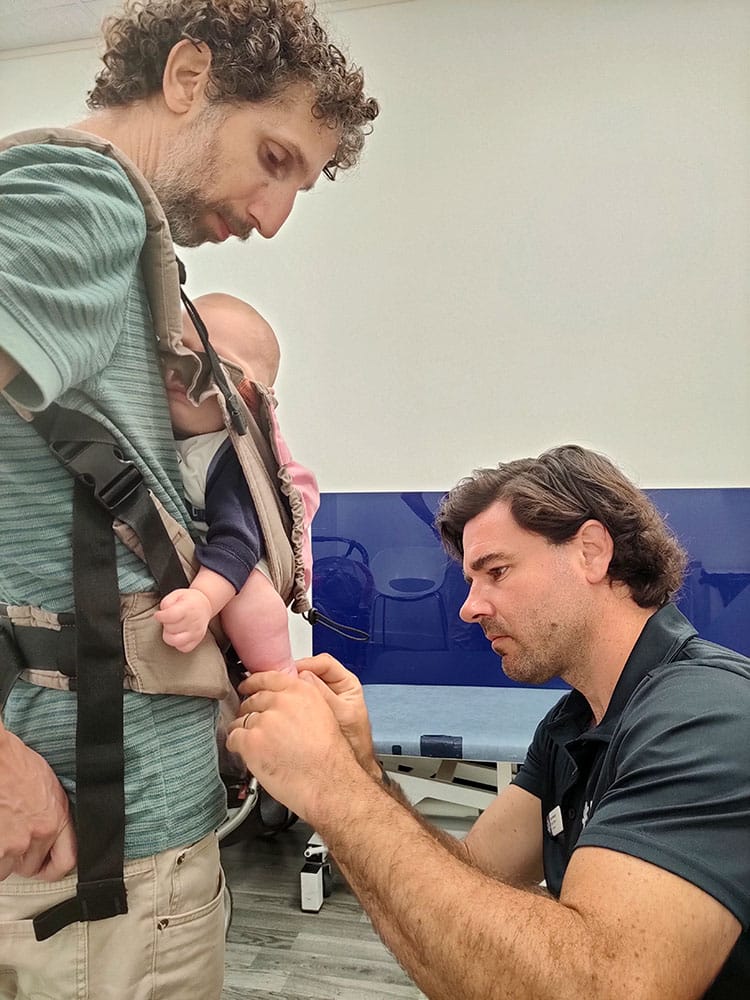
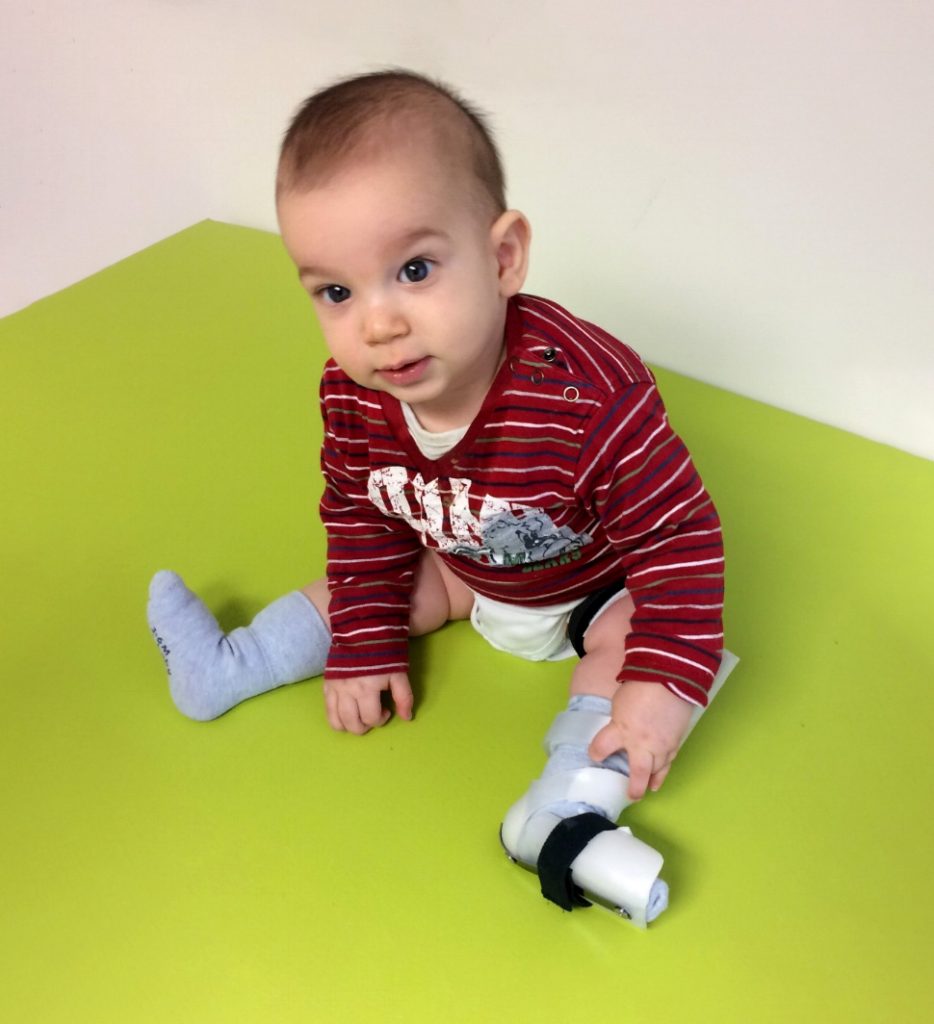
At her 16-week scan, Shira discovered that one of the twins she was expecting had clubfoot in his left foot. At the time, the doctor said, ‘it’s nothing to worry about, it’s very treatable.’
Club foot, also known as congenital talipes equinovarus (CTEV), is a congenital condition in which a baby’s foot is twisted out of shape or position. It’s a fairly common birth defect, occurring in about 1 in every 1,000 births. Club foot can affect one or both feet and may vary in severity.
The characteristic features of a club foot include:
- Foot turning inward (inversion): The front of the foot points downward, and the sole of the foot may face sideways or upward.
- Heel turning inward: The heel is often smaller and may point downward and inward.
- Tight Achilles tendon: The Achilles tendon at the back of the calf is typically shorter than normal.
Not surprisingly, following the diagnosis, Shira hit the internet. What Shira discovered about treatment disturbed her. In Israel, where the family lived, the traditional treatment for club foot, the Ponseti Method, had only been introduced in 2000. Prior to that, foot surgery had been the only option available.
What really upset Shira was what she read about the concluding part of the treatment, often referred to as the Boots and Bar approach. “This seemed to me to be an old-fashioned treatment, particularly as only one foot was affected. Fancy rendering a perfectly normal limb immobile for months if not years. This just did not make sense to me.”
Shira continued to research for a ‘single foot brace’ and found the Cunningham Brace, joined its Facebook group and was really encouraged by what she read. She also discovered that the London Orthotic Consultancy offered the treatment. She had found the solution but now she had to find a physician in Israel who would accept her son as a patient. This took some time, but she did eventually find Louis Schorr, who works at the Wolfson Medical Centre, and although he had never heard of the Cunningham Brace, he had an open mind to alternative treatments. The Wolfson were already treating club foot with an ADM (Abduction Dorsiflexion Mechanism), a single foot brace. In the meantime, Shira had contacted Sam Walmsley, director and lead orthotist at LOC, and they had a video call.
“Sam answered all my questions. We decided that Tal would come out of the cast first into the ADM brace so as not to be under time pressure.”