
Have a question about your condition or treatment options? We’re here to help.
Simply complete our contact form, and a member of our team will get back to you to answer your questions and help you understand the next steps.
We use cookies where necessary to allow us to understand how people interact with our website and content, so that we can continue to improve our service.
We only ever receive anonymous information, and cannot track you across other websites.
View our privacy policyMilestone steps for recent SDR patient Aran
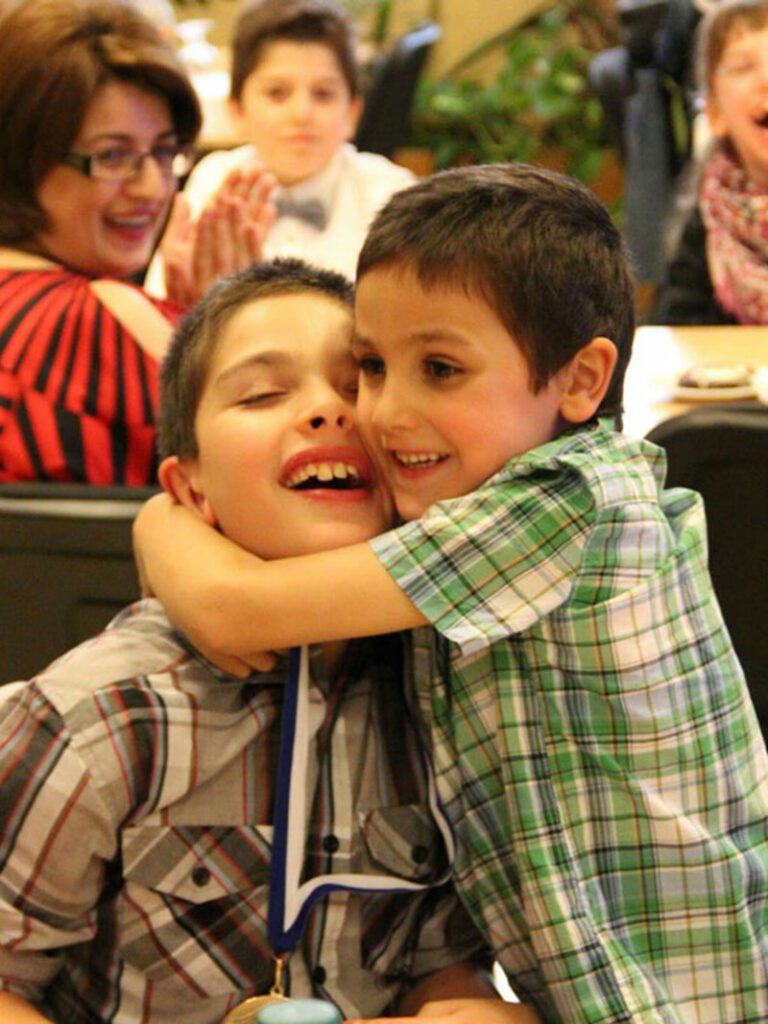
For 10-year-old Aran, the ability to walk independently is becoming reality with the help of the Elaine Owen Clinic, which is run at our Gait Laboratory in Kingston upon Thames.
Aran has diplegia cerebral palsy, which manifests itself in tense muscles and spasms. The leg muscles are particularly susceptible and, over time, joints stiffen, reducing range of motion. Nerve fibres that run from the muscles back to the spinal cord play an integral role in this stiffness.
In 2011, Aran and his parents travelled to America to undergo a type of surgery called selective dorsal rhizotomy (SDR). The operation works by dividing these nerve fibres, which helps to reduce stiffness and spasticity. US advice after such surgery tends to recommend that children are put into regular shoes (plus insoles) as quickly as possible.
Despite the early, tentative success, Aran also experienced some setbacks, including a diagnosis of scoliosis, which required further orthotic treatment. “We were encouraged to get Aran out of orthotics and into shoes,” says his Mum, Kurda. “But, his ankle kept collapsing and we were getting nowhere.”
LOC’s Sam Walmsley says this is a common experience. “A lot of people come back from the States under the impression that their child may never have to wear orthotics ever again. But, in our experience of treating patients after SDR surgery, that expectation can be unrealistic and lead to disappointment. So, it’s better to reframe the goal – let’s reduce the spasticity and help the child become as independent as possible, even if it means the continued use of orthotics. That’s a far more holistic aim: it takes into account the individual child’s circumstances and adapts the treatment to help them reach their personal potential. For us, orthotics and physiotherapy play a very important part in a child’s rehabilitation.”
With that in mind, Sam referred Aran to internationally renowned physiotherapist Elaine Owen MBE. Elaine has spent her career in the NHS working with children with movement disorders, and for the past 20 years has used a gait laboratory to analyse children’s walking, optimise orthosis designs and set physiotherapy programmes. She has developed a comprehensive method of assessment, prescription and fine-tuning of lower limb orthoses, challenging conventional wisdom with evidence-based science and rewriting the textbooks. Her methods are now the gold standard for designing, aligning and fine-tuning lower limb orthoses.
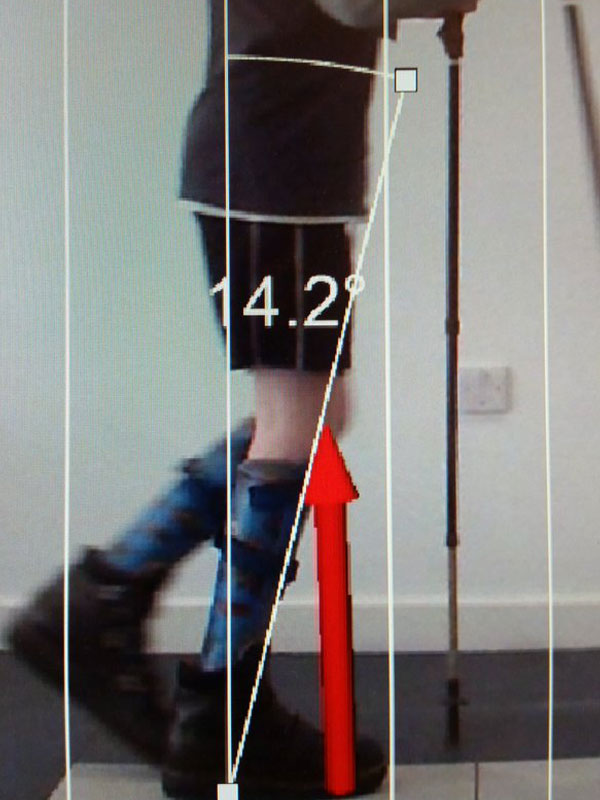
LOC’s Gait Lab technology illustrating how clinicians observe the pressures and forces involved during a walking exercise. These observations lead directly to the precise creation of bespoke orthotics designed to fit the patient’s individual requirements.
We run a clinic supported by our high-tech video vector gait laboratory. The lab uses specialist cameras that synchronise with a highly sensitive force plate. This measures forces in three directions, helping us build a clear picture of how pressure moves through the foot and up the leg during walking. We use this information to fine-tune orthoses so they support you as effectively as possible.
Although Aran had two previous three-dimensional gait assessments through the NHS, the data was not collected specifically to guide orthotic treatment. In Kurda’s view, what made the difference was our ability to use gait lab data to fine-tune a bespoke solution for Aran, supporting his post-operative progress.
For Aran, the result was dramatic: the day after he received his new ankle-foot orthotic (AFO) he was able to walk unaided for the first time. It was Mother’s Day. “On the first video we made, all you can hear is me crying,” says Kurda. “After 10 years of daily physiotherapy and swimming, not to mention SDR, hamstring and tendon lengthening, we have finally achieved independent walking – it was a mother’s day gift that would take some beating.”
Aran has now managed to walk five metres unaided – that’s the equivalent of five hundred miles for a child who has never experienced such independence. “I think having something that fits so well and feels comfortable gave him the confidence to know that he was not going to fall,” says Kurda. “But he also faces a challenge in getting used to this progress and what it means for him. I think if you have spent all your life having to hold on to something, to then have that taken away must be very strange. He’s got the physical strength, it’s now about the psychological aspect of adapting to his newfound independence and building his progress from there.”
Nonetheless, Kurda is delighted with Aran’s progress and with her experience of working with LOC. “A pair of Aran’s AFOs got split and LOC simply replaced them without charge or questions. It’s that kind of thing that makes a massive difference. My advice to other parents is to talk to someone who has been through it, get the facts for yourself. The impact this has had on my child had been enormous.”
We have the following facilities and amenities at our Kingston Upon Thames location: We also have the Gait Laboratory for orthotics patients and Onsite Manufacturing for speedy turnarounds and adjustments whilst you wait.
We have the following facilities and amenities at our Cambridge location:
We have the following facilities and amenities at our Bristol location: For more information, visit Litfield House Medical Centre.
We have the following facilities and amenities at our Romford location: Parking: There is NO parking directly outside the clinic. These spaces are reserved for residents. The nearest parking can be found at Billet Lane public pay & display opposite Queens Theatre, a 2-minute walk from the clinic. Click here for more information about Best Health Clinic
LOC’s clinic is based in the University of Salford’s Podiatry Department and provides treatments for orthotics, scoliosis, pectus deformities, positional plagiocephaly and club foot. It is also the base for LOC’s northern OSKAR clinic which is run by Sam Walmsley, clinical director of LOC, in conjunction with Elaine Owen MBE MSc SRP MCSP.
Due to COVID-19, we have had to temporarily close the Salford clinic and are operating out of another clinic in Bolton. 508 Blackburn Rd, Astley Bridge, Bolton BL1 8NW For more information, please visit The Good Health Centre
At LOC, we specialise in designing clinically-led, bespoke orthotics that make a meaningful difference to patients with cerebral palsy. Our orthotics don’t just offer support, they’re precision tools used to improve mobility, stability and gait, based on in-depth assessment and advanced biomechanical analysis.
Every orthosis we create is the result of careful planning, goal-setting and fine-tuning, tailored to support each child’s development and unique functional needs. Giving children the best possible foundation for movement, independence and participation.

Have a question about your condition or treatment options? We’re here to help.
Simply complete our contact form, and a member of our team will get back to you to answer your questions and help you understand the next steps.
