As a child, Sarah* (now in her thirties) contracted polio, leading to years of orthopaedic surgery, physiotherapy, and orthotic treatment.

Despite the challenges of her condition, Sarah has never allowed polio to stop her living life.“Generally, like most people with polio, I have always been very active,” she explains. “During the earlier years, I didn’t tend to experience significant problems; I just got on with it. It was only when I hit my thirties that I started to have a lot of new symptoms. It took a couple of years of tests before the clinicians diagnosed post-polio syndrome (PPS) and put me under the care of a specialist team.”

Sarah’s care on the NHS has always included the use of orthotics. “Even as a child, I struggled a bit with wearing them,” she says. “But I went with it, because at that time it didn’t really restrict me; it was just something to deal with. But, once post-polio was diagnosed, orthotics suddenly became extremely important because my new condition of PPS was greatly impeding my ability to walk. I had a lot of unexpected falls. I went to so many different orthotists who, between them, tried three different types of orthotics to help me. Unfortunately, it’s not a stretch to say that I found them very painful and difficult to wear. After nearly forty years of using orthotics, it was quite a shock to experience an orthotic that I simply couldn’t use.”

“It’s no exaggeration to say that, when I arrived at LOC’s doors, I was desperate to find a solution that actually worked for me. I would say to anyone in a similar situation, just go. Even if you’re not sure whether the private route is right for you, go for the consultation. Sam and his team are exceptionally knowledgeable and explain everything so well.”

Sarah

Keen to find a different solution that would help her live pain free, and continue her previously active lifestyle, Sarah decided to investigate private options.

“Initially, I went back to the Royal National Orthopaedic Hospital, who were originally in charge of my paediatric care. The orthotists there told me about LOC and recommended Sam (Sam Walmsley, Director and Lead Orthotist at LOC). My rehabilitation consultant at St Thomas’s Hospital also knew Sam, as did a friend of mine who is a prosthetist. Everywhere I went on my orthotics journey, Sam’s name came up!

As well as those multiple endorsements, I was drawn by LOC’s accessibility, Sam’s ability to respond quickly to my queries, and the range of services they have on-site. They have a gait laboratory in-house; they manufacture the orthotics in-house. That makes a huge difference both to the turnaround time to create an orthotic and also their ability to fit and tweak it without having to send it out to an external team.”

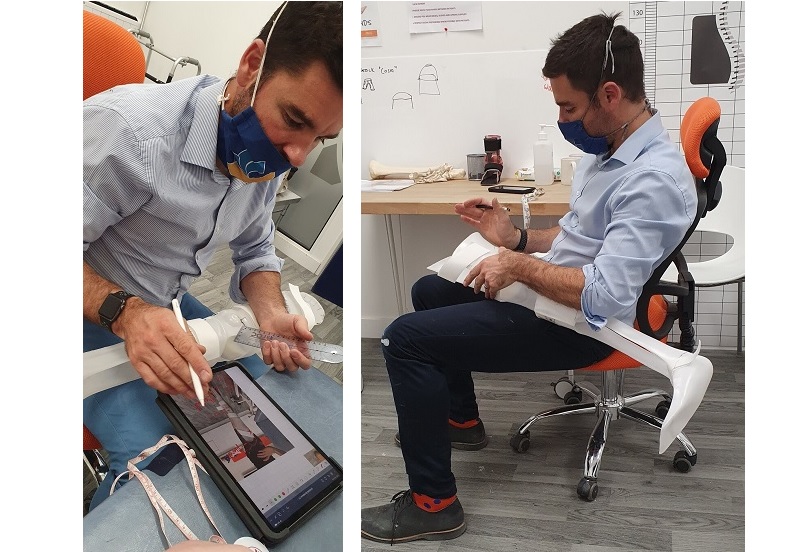
Sam confirms that, after assessing Sarah’s case, he created a bespoke Neuro HiTronic stance control KAFO. Unlike traditional “locked” leg braces, this KAFO locks and unlocks to provide stability whilst also allowing the wearer flexible knee movement during the swing phase of walking. “We started by taking a 3D scan of Sarah’s leg which in itself is unusual when designing a KAFO,” he says. “Then we made her a plastic fitting to check that everything was correct and that the line and fit were precise.

We used Victor, our 7 axis CAD CAM milling robot, to mill out the test moulds before moving to carbon fibre manufacture. There was a very detailed process of refining the design and fit, and this was all done in-house. I remember the moment when Sarah tried her KAFO for the first time. It was emotional for everyone involved. She seemed delighted with the fit and comfort it provided. I really think this is one of the best results I have ever had for a patient.”

“Thanks to LOC’s work, my pain is substantially reduced, and my independence is substantially increased. It hasn’t taken away the fact that I have a disability, but it has improved my quality of life and mobility and helped me to focus on a long-term plan to prevent my physical difficulties getting worse.”

Sarah

Sarah confirms that she was genuinely thrilled when she tried her KAFO on in clinic. “The effect was absolutely immediate. It fitted like a glove. I remember saying, ‘This is the leg I feel I should have been born with.’. I could bend my knees when walking, which is something I hadn’t been able to do for a long time. I did a little dance and hugged my husband. There were certainly a few tears. It’s no exaggeration to say that I was overwhelmed with joy!”

That said, Sarah is keen that other patients in a similar situation understand the natural challenges of adapting to a new orthotic. “The KAFO is perfectly designed for me. But it is important to realise that, in clinic, you’ve got flat, even surfaces to try it out on. You also have Sam and his team on hand to examine the fit and make adaptations for maximum comfort. I found that, when I got home, I needed a period of time to adjust to all those things you don’t experience in clinic: uneven floors, stairs, cracks in the pavement, and so on. But in my experience, that’s a natural part of the process.

The problem with an ill-fitting KAFO like I had previously is that it can encourage poor walking habits. You compensate for that in ways that cause other problems. It takes time and work, as well as the right orthotic, to address that. But, thanks to LOC’s work, my pain is substantially reduced, and my independence is substantially increased. It hasn’t taken away the fact that I have a disability, but it has improved my quality of life and mobility and helped me to focus on a long-term plan to prevent my physical difficulties from getting worse.”

Seven months on from her initial fitting, Sarah is still thrilled with her KAFO and delighted with the treatment she has received at LOC.

“They take the time to talk to you about the biology, the mechanics, and why the problems you are experiencing have arisen. I learnt so much. For the first time, I understood why I was having frequent falls, even with my orthotics on, and how my old GrAFO was making me biomechanically unstable. I didn’t even know what that meant until Sam explained it!”

I’ve been using orthotics for thirty years, and I have always made do with whatever I have been given. As long as it got me on my feet, I’d go out to work, do my thing, come back, and collapse into bed. I wasn’t a complainer. But, after two years of wearing my main KAFO, I knew that the severe pain and discomfort I was experiencing simply wasn’t right. Sam validated that for me. He was able to show me that I wasn’t the problem, and he found a solution. That first visit to LOC is about taking a positive step for yourself. Take that first step, and the path will open up if it’s right for you.”

*Patient’s name has been changed as she preferred to share her testimony anonymously.

Bespoke orthotics for post-polio syndrome (PPS)

Improve your mobility, reduce fatigue and manage symptoms of post-polio syndrome with bespoke orthotics

“Thanks to LOC, my pain is substantially reduced, and my independence is substantially increased. It hasn’t taken away the fact that I have a disability, but it’s improved my quality of life and mobility”

Sarah, post-polio syndrome patient

Get in touch for a free online orthotic consultation

Speak to our team about your options, with no obligation to begin treatment.

Not sure which appointment to book?

  • New patients: Please book an Assessment.
  • Existing patients: Please book a Review.

If you can’t find a suitable appointment, please contact us and our admin team will be happy to help.

020 8974 9989
Maximum file size: 2MB. Accepted file types: JPG, JPEG, PNG

By submitting this enquiry form you agree to our terms & conditions as outlined in our privacy policy. We will never sell your data and have strong security.