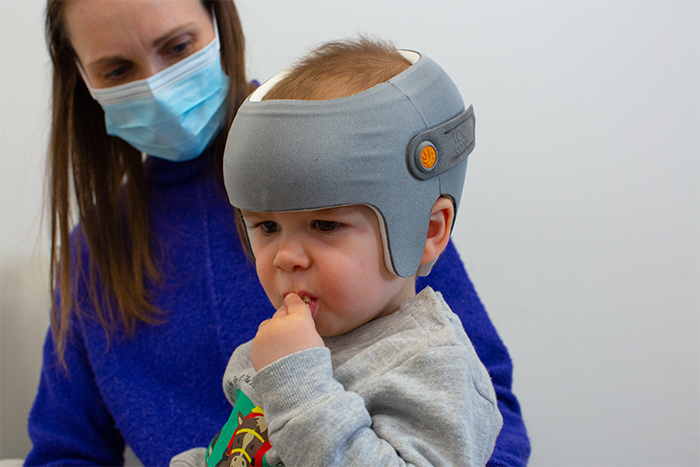
When Sophie noticed her baby Max had a persistent flat spot on his head, she was told it would resolve naturally, but it didn’t. Seeking a second opinion led her to the London Orthotic Consultancy, where Max was assessed as having severe plagiocephaly.

At birth Max had a normal looking head shape. At about three months, his mother Sophie noticed that his head looked flat on the right hand side. She recalls: ”Max always did have a preference for sleeping on the right side of his head and indeed always seemed to prefer looking to his right, it was just his thing.”

Max’s symptoms were a classic presentation of positional plagiocephaly or ‘flat-head syndrome’ as it is often called. Until about one year of age, the bones of a baby’s head are very thin and flexible, which makes its head soft and easy to mould. Max’s right-sided preference meant that he spent more time inadvertently putting pressure on one part of his skull.

Over the following months, Sophie asked her GP, Health Visitor and nurse at her GP surgery, about Max’s flat head. The response each time was the same: “It will resolve itself as Max grows”. But it didn’t. Sophie was galvanised into seeking a second opinion by her sister.

They were on a family holiday in Cornwall and Sophie’s sister said: “You know I’m afraid Max’s head shape is really bad and it’s not getting any better”. She even started searching for a solution and found LOC’s clinic in Kingston. Sophie phoned LOC while she was still on holiday in Cornwall and arranged a face-to-face appointment for their return from holiday. The appointment was made with Jo Drake, LOC’s Head for plagiocephaly and Senior orthotist.

At Max’s orthotic assessment, Jo found that he had severe right-sided plagiocephaly. Max’s cranial vault asymmetry was 16mm; this measurement compares the right and left diagonals at 30 degrees from the centre of the head (front to back) and subtracting one from the other gives the asymmetry value. Anything over 12mm is considered to be severe.

Commenting on that appointment, Sophie said: “Jo was reassuring, while not over-promising about what improvements could be made to Max’s head shape. Having now read up on the subject, I was only too aware that we were starting treatment late, as Max was over 10 months of age when his head was scanned.” The optimal age for starting treatment is considered to be 4 to 5 months.

Cranial remoulding therapy (as it is called) works by applying gentle and constant pressure over the areas of a baby’s skull that are most prominent while allowing unrestricted growth over the flattened areas, so it is best to start treatment when a baby’s head is growing quickly and before growth stops at around the 18 month mark.

Max had no problems with his ‘helmet’. Indeed, as Sophie observed: “It probably saved him from any number of bumps and bruises on his head as he rushed about!”

By the end of treatment, Max’s asymmetry had improved to 9mm, in the moderate range. Sophie commented: “We knew it was unlikely that it would be possible to get his head back into what is termed the ‘normal’ range, Jo had been quite clear about that from the very beginning, but you can see from the scans how much better his head looks.

I’m also very pleased that his facial features and eyes are now much more symmetrical. I must add that “Jo was great throughout the process; she clearly has a vast amount of experience supporting babies with this condition and is a thorough professional.”

Scan of a Max
Max’s asymmetry went from 16mm at the start of treatment to 9mm at his final review

If you’re concerned about your baby’s head shape, get in touch today. You can complete our free flat head photo assessment form or, to book a free consultation with an orthotist, contact us.

*Patient and mother’s names have been changed as they preferred to share their testimony anonymously.

How the LOCband Lite can help with plagiocephaly treatment

Backed by clinical research, LOCband Lite is a non-invasive cranial remoulding helmet designed to support a more balanced head shape over time. Results vary depending on age, severity and daily wear time.


“From the very start, everyone at the London Orthotic Consultancy was professional and friendly. Every step of the way was well-explained and the fitting was quick. It only took Magnus one day to get used to the band, and after that, he wasn’t bothered by it at all. And, most importantly, it worked!”

Maria, Magnus’s mother – Plagiocephaly patient

Get in touch for a free online orthotic consultation

Speak to our team about your options, with no obligation to begin treatment.

Not sure which appointment to book?

  • New patients: Please book an Assessment.
  • Existing patients: Please book a Review.

If you can’t find a suitable appointment, please contact us and our admin team will be happy to help.

020 8974 9989
  • We kindly ask for at least 48 business hours’ notice for cancellations or rescheduling. Cancellations made after this period may be subject to a fee. For full details, please refer to our Terms and Conditions.

  • Yes, if your previous orthotist offers online booking and has availability, you can choose to book with them again.


  • Please check your spam or junk folder first. If you still haven’t received a confirmation within 10 minutes, contact LOC Admin to confirm your booking via [email protected]


  • Yes. You can book on behalf of someone else. Please ensure the registration form includes the details of the person attending the appointment.


  • No account is required. Our booking process allows you to book as a guest. However, you will be asked to enter key details and complete required forms.


  • Most orthotic treatments are available online. If the treatment you’re looking for is not listed, please contact us directly and LOC Admin will assist you.


Get in touch for a free online orthotic consultation