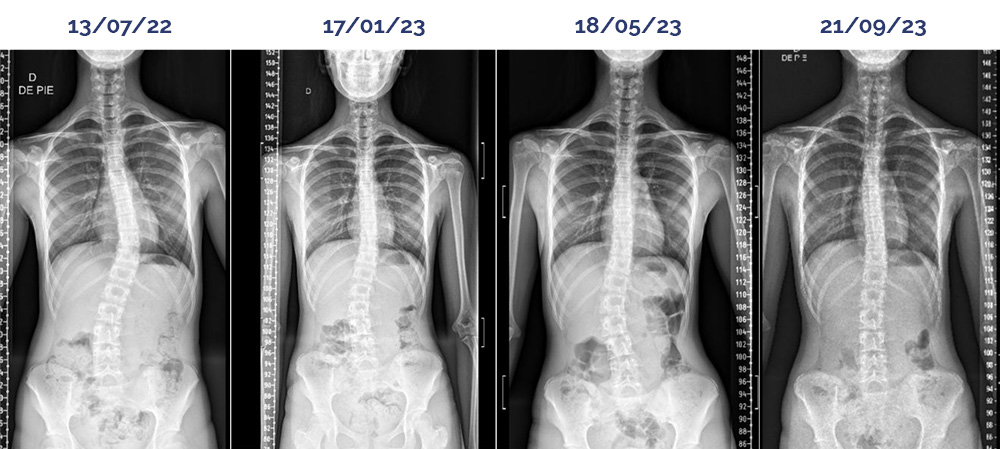
After initial bracing options in Chile fell short of expectations, Matilde’s father Felipe, a medical doctor, researched the best brace technologies worldwide. LOC’s corrective scoliosis brace and Schroth-based therapy stood out.
Matilde’s parents first discovered she had scoliosis in the summer of 2022. Her father, Felipe was reading up about the medical checks that should be done in adolescence and idiopathic scoliosis was on the list.
“We realised that our GP had never done this, and we then noticed a slight asymmetry in her back. We weren’t worried, as Matilde had a good posture and was a keen climber and did other sports too, but we asked her GP for a scan just to be sure. She explained to us that a full spinal x-ray was removed from the standard of care years ago and is only taken when scoliosis is suspected.”
However, after a visual assessment, a scan was recommended and revealed a diagnosis of adolescent idiopathic scoliosis. Matilde was referred to a spinal surgeon, who outlined the different treatments available, including surgery. Matilde’s Cobb angle was 29 degrees and, therefore, rated as moderate to severe.
Matilde was referred for bracing treatment. The best scoliosis treatment available in Chile is a traditional brace (like the Boston brace available on the NHS). The surgeon told the family that the idea of the brace was to hold the curve and try to decrease the progression so surgery could be avoided.
Felipe recalls, “Matilde struggled with the idea of wearing it, but she did it. She is incredibly resilient. However, given the limited ambitions of the bracing treatment available in Chile, we started research focused on finding the best available brace technology to find a brace treatment that would help her more.