This story shares one person’s experience of scoliosis bracing. Everyone’s scoliosis is different and outcomes vary. Bracing is one part of scoliosis care and should sit alongside medical oversight, such as a spinal consultant, particularly where imaging and surgical decision-making are involved.
Alex, aged 13, was referred to us from Parkside Hospital last summer. At that time, his x-ray showed a small spinal curve. As the Cobb angle measured under 10 degrees, no bracing was recommended by his medical team.
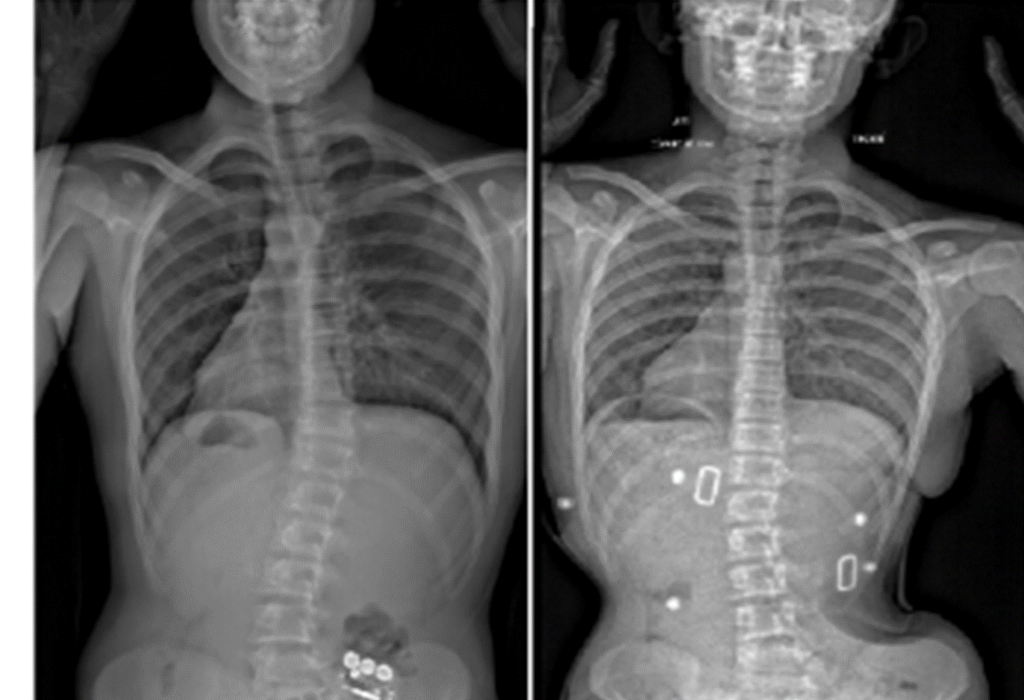
More recent imaging later confirmed a general thoracolumbar curve, convex to the right, with a Cobb angle measured at 22 degrees. Because the curve appeared to be progressing, Alex’s specialist discussed the wider management pathway and referred him to our orthotics team to explore asymmetrical scoliosis bracing as a non-surgical management option.
Alex has been wearing his brace full time, aiming for around 22 hours per day, and has found it comfortable enough to fit around day-to-day life.
Alongside bracing, Alex has been following daily Scoliogold exercises with Scoliosis SOS, our physiotherapy partner. This forms part of his wider physiotherapy support, while we continue to focus on the orthotic bracing side of his care.
Early in-brace measurements
After six weeks of bracing, in-brace measurements showed an overcorrection position to -5 degrees at the time of assessment.
It’s important to note that in-brace correction reflects the position achieved while wearing the brace. It does not, on its own, predict long-term outcomes, and results vary depending on factors such as curve type, growth stage and adherence to wear time.
A bespoke brace design for type 1 diabetes
One additional consideration for Alex is that he has type 1 diabetes. We adjusted the brace design to accommodate his insulin pump, so it could be worn safely and comfortably as part of his day-to-day routine.