Have a question about your condition or treatment options? We’re here to help.
Simply complete our contact form, and a member of our team will get back to you to answer your questions and help you understand the next steps.
We use cookies where necessary to allow us to understand how people interact with our website and content, so that we can continue to improve our service.
We only ever receive anonymous information, and cannot track you across other websites.
View our privacy policyNew AFOs help Grace, who has cerebral palsy, out of her wheelchair and walking again
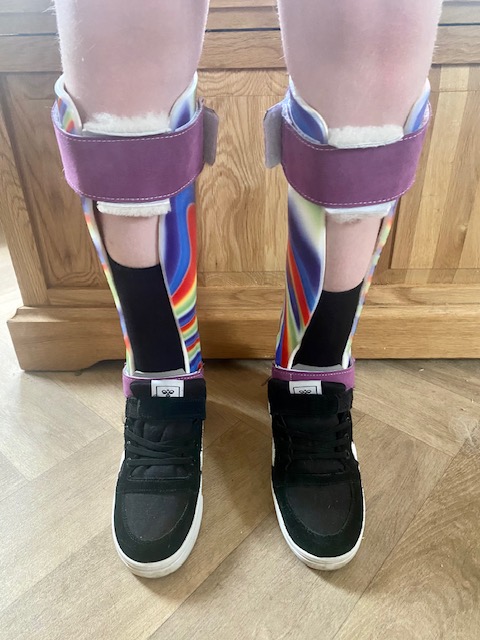
Grace was a premature baby (three months) and was seriously ill at birth and her cerebral palsy was diagnosed at the age of two.
Cerebral palsy (CP) is the term used to describe a group of conditions that affect the movement of muscles and the posture of the body. The term comes from the area of the brain affected, ‘cerebral’ refers to the brain (cerebrum) and ‘palsy’ is the disorder of movement or posture. It is estimated that one in 400 babies born in the UK has a type of cerebral palsy.
Grace has spastic quadriplegia which means all four limbs can be affected as well as the trunk. Once diagnosed, Grace was in the care of the NHS and prescribed splints (also known as Ankle Foot Orthoses) and blocks of physio to help with her condition. Life carried on until COVID struck. Because of her health, Grace had to shield. However because the NHS stopped face-to-face treatments, Grace developed contractures in her legs and had a lot of pain in her legs and hip.
Grace’s current splint was ill-fitting and causing blisters but the NHS said they could not be replaced for at least a year. At the same time, Grace’s parents were told that there was a 12-month waiting list for the surgery to sort out the contractures in her legs. By this stage, Grace was almost confined to her wheelchair. It was at this point that Grace’s parents sought private help.
Grace underwent surgery for tendon release at The Portland Hospital on 3 March this year. After the surgery, Grace was seen by Mr Norman Taylor, a consultant at Great Ormond Street Hospital, who said to Jeanette (Grace’s mum) “You need to see Sam at the London Orthotic Consultancy about Grace’s orthotics.” Jeanette duly rang up LOC and was delighted to find that LOC had a clinic in Cambridge, where the family live. Grace was assessed in May.
“Connor has been fantastic with Grace, who is autistic… he just gets it and very quickly built up a rapport. He never speaks over her to me and communicates directly with her, which is so different to what she was used to elsewhere.”
Jeanette , Grace's mum
Jeanette takes up the story: “You could make a very long list of the differences in treatment Grace has received from LOC. First up, there is the Gait Laboratory which you don’t get on the NHS, Connor (who heads up LOC’s Cambridge clinic) immediately advised that Grace needed splints on both her legs as her CP was affecting both limbs and then he said she needed specialist shoes as Grace has abnormally small feet and to make room for her AFOs she needed shoes 2 sizes bigger than her current ones. And then there was no messing about with casting, Connor just scanned her legs and that was that.
On a very important level, Connor has been fantastic with Grace, who is autistic. She can communicate but she needs to be talked to in the right way to get her to respond properly. Connor just gets it and very quickly built up a rapport with Grace, he never speaks over her to me and communicates directly with her, so different to what Grace was used to elsewhere. And then we get to the end product, the AFOs themselves. There is no comparison, they are tailor-made, padded for comfort and fit properly – no rubbing. You can’t really believe the difference: Grace hardly uses her wheelchair anymore; she has full mobility and is pain-free.”
Our clinicians have extensive experience in improving mobility and independence in children with cerebral palsy.
If you think your child would benefit from an assessment with one of our specialist clinicians, please book an appointment using our contact form.

At LOC, we specialise in designing clinically-led, bespoke orthotics that make a meaningful difference to patients with cerebral palsy. Our orthotics don’t just offer support, they’re precision tools used to improve mobility, stability and gait, based on in-depth assessment and advanced biomechanical analysis.
Every orthosis we create is the result of careful planning, goal-setting and fine-tuning, tailored to support each child’s development and unique functional needs. Giving children the best possible foundation for movement, independence and participation.

Have a question about your condition or treatment options? We’re here to help.
Simply complete our contact form, and a member of our team will get back to you to answer your questions and help you understand the next steps.