Speak to our team about your options, with no obligation to begin treatment.
If you can’t find a suitable appointment, please contact us and our admin team will be happy to help.
We use cookies where necessary to allow us to understand how people interact with our website and content, so that we can continue to improve our service.
We only ever receive anonymous information, and cannot track you across other websites.
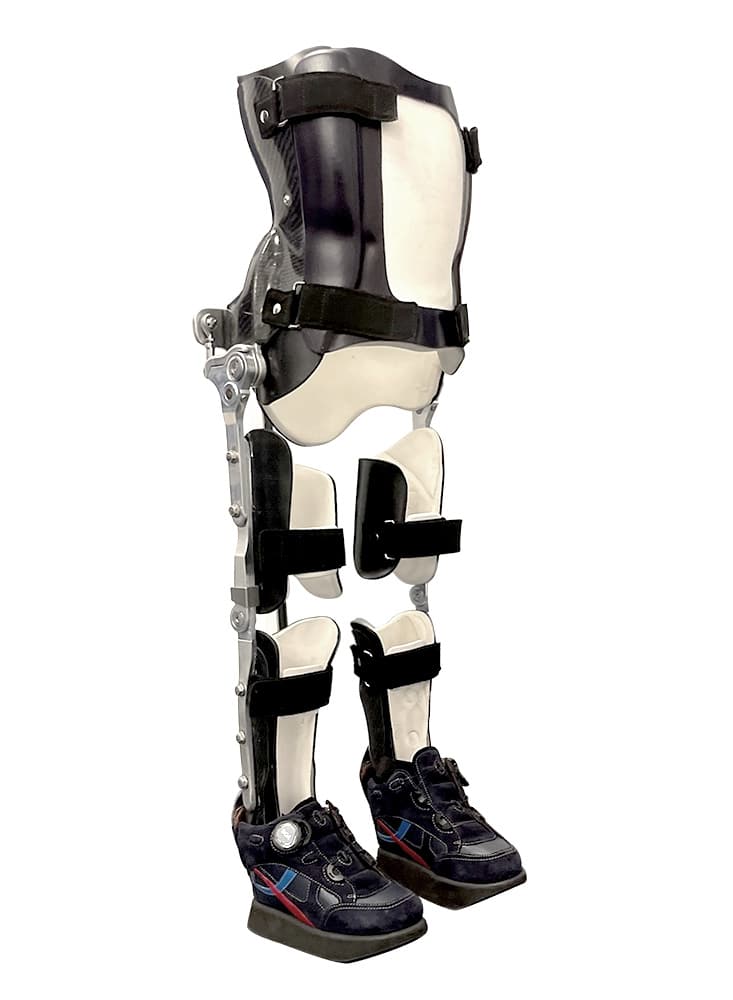
View our privacy policyA Reciprocating Gait Orthosis (RGO) is a type of orthotic device, specifically a type of hip-knee-ankle-foot orthosis (HKAFO) and one of the most complex orthoses available. It can help patients with lower limb weakness or paralysis to walk by providing support and facilitating a natural, reciprocal gait pattern.

A reciprocating gait orthosis (RGO) is a specialised orthopaedic device designed to assist individuals with mobility impairments achieve a more natural walking pattern.
It’s made up of jointed metal frames, straps, and components that attach to the wearer’s legs and torso. The primary function of an RGO is to mimic the natural walking motion by coordinating the movement of both legs. So when one leg moves forward, the other moves backward. This coordinated movement allows for a smoother and more efficient walking experience.
RGOs are equipped with hinges at the hip and knee joints, which enable dynamic movement and better coordination. They also include a locking mechanism that provides stability during standing or resting phases. The user initiates movement through weight shifting or the use of assistive devices, while the RGO converts this motion into a controlled, reciprocal gait pattern.
Reciprocating gait orthoses significantly benefit individuals with lower limb weakness or paralysis by enhancing mobility and promoting greater independence in walking. Many potential candidates for the RGO may otherwise rely on a wheelchair or a walker to be mobile.
Some of the key advantages of RGOs include:
RGOs are particularly beneficial for individuals with mobility impairments due to various medical conditions. Some of the most common conditions where RGOs are prescribed include:
After spinal surgery and chemotherapy at age three, Ted was left with a spinal injury and given a heavy, outdated orthosis that only allowed limited standing. Concerned about his declining progress, his mother sought help from The London Orthotic Consultancy (LOC).
Lead clinician Sam Walmsley assessed Ted and found issues with his existing orthotics, including poor alignment and lack of foot support. Given Ted’s strong upper body and core, the team recommended a lighter, more functional RGO with Fixed Ankle AFOs and specialised footwear.
Since receiving the RGO in April, Ted has made significant progress. Standing for longer and walking with a frame. Ted’s determination and enthusiasm have contributed to his progress.
Mum Joanne commented: “He’s really doing well with it and can now stand for considerable lengths of time; he can also walk in it with the help of his walking frame. The videos say it all really. Sam has been great with Ted.“

At LOC, we specialise in the design and manufacture of bespoke RGOs, particularly for patients with spinal injuries. Our clinical team has extensive experience in assessing and fitting these complex orthoses to ensure the best possible outcomes for our patients.
We manufacture our RGOs in our Kingston clinic, allowing for meticulous control over the process and ensuring optimal quality. Traditionally, RGOs required a plaster of Paris casting for fitting, but our advanced 3D scanning process eliminates the need for casting, reducing patient stress and discomfort.
We also use computer-aided design (CAD) technology to refine the alignment and fitting process, resulting in a superior orthotic device.
Once an RGO is fitted, regular maintenance and optimisation are crucial to ensure continued effectiveness. We provide an on-site servicing and use our video vector gait laboratory to fine-tune alignment and optimise rehabilitation progress over time.
By combining cutting-edge technology with expert clinical care, we ensure that our patients receive the best possible support in their journey towards improved mobility and independence.


Speak to our team about your options, with no obligation to begin treatment.
If you can’t find a suitable appointment, please contact us and our admin team will be happy to help.