
Have a question about your condition or treatment options? We’re here to help.
Simply complete our contact form, and a member of our team will get back to you to answer your questions and help you understand the next steps.
We use cookies where necessary to allow us to understand how people interact with our website and content, so that we can continue to improve our service.
We only ever receive anonymous information, and cannot track you across other websites.
View our privacy policyThis case report shows how switching from plastic to carbon-fibre AFOs improved the way an 8-year-old girl with spastic diplegic cerebral palsy walked and ran, with AI-assisted gait analysis measuring changes in posture and whole-body mechanics.
Advances in orthotic design and digital gait analysis are changing how we understand movement in children with neurological conditions. At LOC, we are increasingly seeing the benefits of carbon-fibre orthoses for paediatric patients, and, crucially, we’re now able to objectively measure those benefits using AI-assisted gait analysis.
Children with cerebral palsy commonly present with toe walking, excessive pronation, reduced stability, poor trunk posture and early fatigue, particularly during higher-demand activities such as running and play. While conventional plastic AFOs often improve foot and ankle alignment, their influence on proximal control and dynamic posture can be limited.
This research case, carried out by Professor Saeed Forghany at our Manchester clinic, highlights how modern carbon-fibre orthoses, combined with AI-driven gait analysis, can provide insight into changes occurring not only at the foot and ankle, but throughout the kinetic chain, including pelvis and trunk control.
The patient was an 8-year-old girl diagnosed with spastic diplegic cerebral palsy. She presented with persistent tiptoe walking, severe overpronation, knee hyperextension, marked forward trunk lean during walking and running, reduced endurance during running, and limited functional improvement with long-term use of plastic AFOs.
A comprehensive gait assessment was carried out using LOC’s AI-assisted gait analysis system.
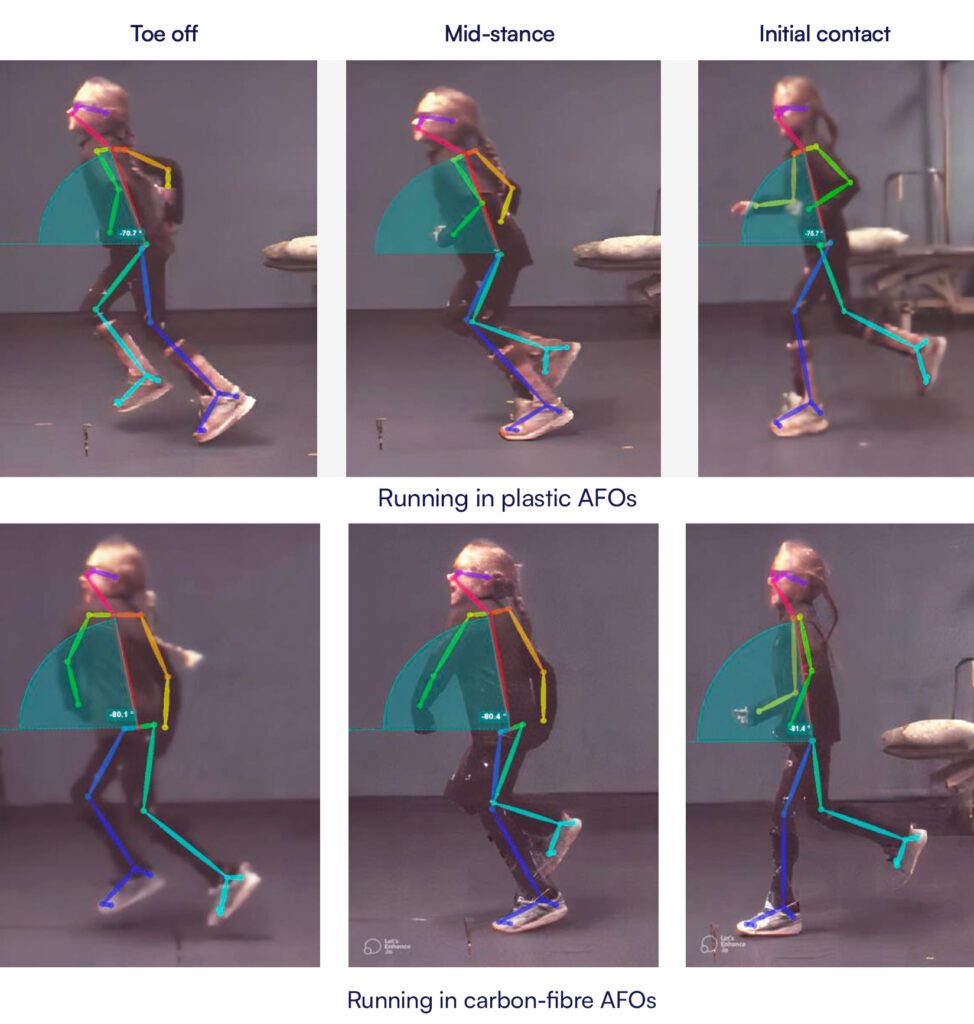
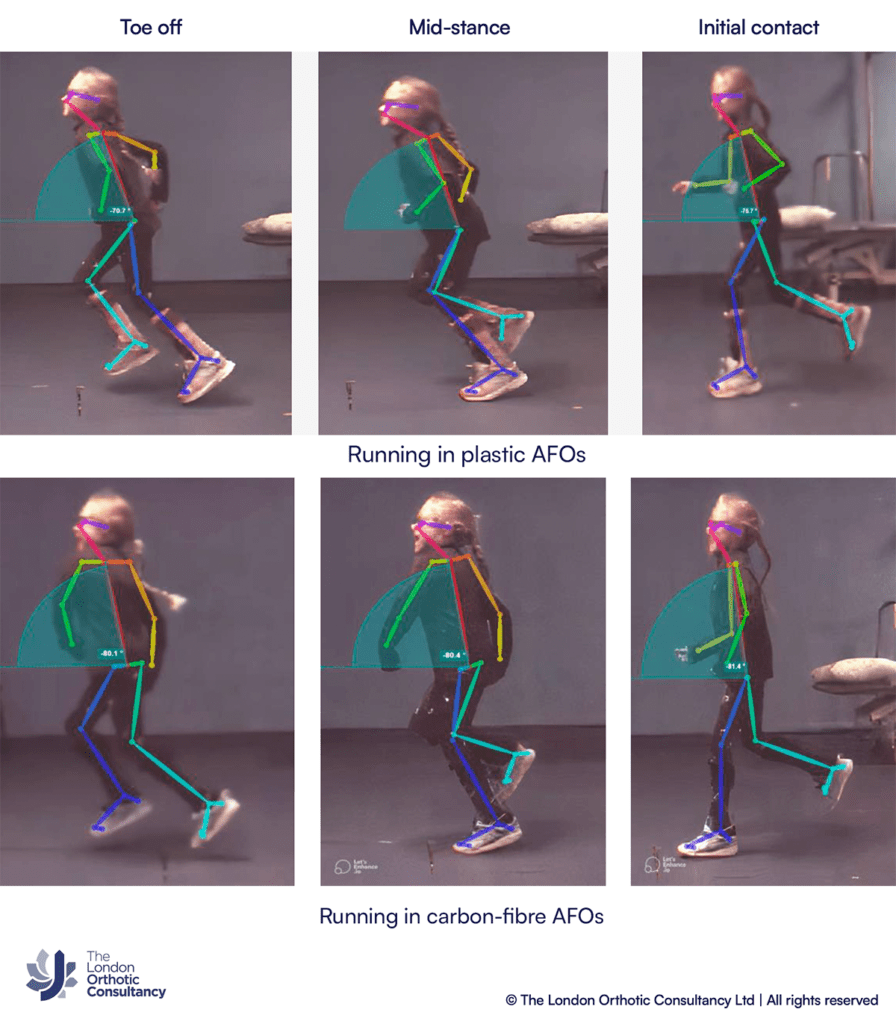
When walking and running barefoot, she demonstrated significant forward trunk lean and poor midfoot control. Plastic AFOs improved foot position and ankle alignment; however, improvements in trunk posture during walking and running remained limited (Figure 1).
Given the ongoing functional challenges, a transition to custom carbon-fibre AFOs was recommended.

Carbon-fibre AFOs offer greater stiffness, improved control of ankle motion, more effective alignment of ground reaction forces and enhanced energy return compared to traditional plastic designs.
These mechanical properties were expected to support a more upright posture by influencing not only distal alignment, but also proximal stability during both walking and running (Figure 2).
AI-derived gait metrics revealed clear differences between plastic and carbon-fibre AFOs, particularly during running.
Forward trunk lean was reduced by approximately 35–50% across initial contact, mid-stance and toe-off when running in carbon AFOs compared to plastic AFOs (Table 1). Reductions were consistent across gait phases, with trunk lean decreasing from approximately 14–19° in plastic AFOs to under 10° in carbon AFOs.
These findings suggest a meaningful improvement in whole-body alignment and running mechanics.
When running in carbon-fibre AFOs, the young girl demonstrated a more upright trunk posture, improved symmetry, greater dynamic stability and reduced observable fatigue.
Functionally, running appeared more efficient and less physically demanding.
A comfort and fit review is planned at 6 weeks, with a repeat AI-assisted gait analysis scheduled at 3 months to assess longer-term adaptations and consistency of gait improvements. You can download the full case report here.
If you’d like to know more about our carbon-fibre orthoses and how they could help your child with cerebral palsy, get in touch.
At LOC, we specialise in designing clinically-led, bespoke orthotics that make a meaningful difference to patients with cerebral palsy. Our orthotics don’t just offer support, they’re precision tools used to improve mobility, stability and gait, based on in-depth assessment and advanced biomechanical analysis.
Every orthosis we create is the result of careful planning, goal-setting and fine-tuning, tailored to support each child’s development and unique functional needs. Giving children the best possible foundation for movement, independence and participation.

Have a question about your condition or treatment options? We’re here to help.
Simply complete our contact form, and a member of our team will get back to you to answer your questions and help you understand the next steps.
