
Speak to our team about your options, with no obligation to begin treatment.
If you can’t find a suitable appointment, please contact us and our admin team will be happy to help.
We use cookies where necessary to allow us to understand how people interact with our website and content, so that we can continue to improve our service.
We only ever receive anonymous information, and cannot track you across other websites.
View our privacy policyDrop foot describes when a person has trouble lifting the front part of the foot, making it difficult to walk.
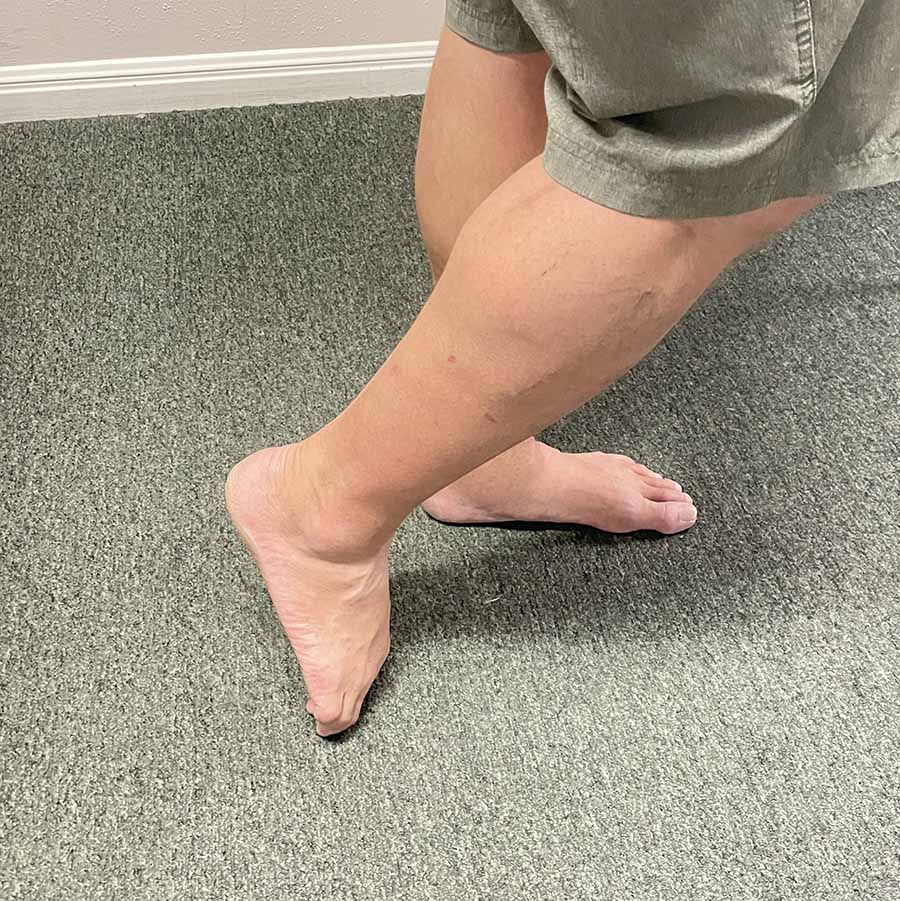
Drop foot, also known as foot drop, is when a person cannot lift the front part of their foot properly. This can cause the toes to drag while walking, increasing the risk of trips, instability, and balance issues. It may affect one or both feet and can significantly impact mobility.
It occurs when the muscles that allow the ankle and toes to flex become weak or damaged, making it difficult to move them upwards (dorsiflexion).
People with drop foot will often walk with their raised leg bent at the knee to compensate for the front of the foot ‘dropping’ and dragging along the floor.
Drop foot is not a disease in itself but rather a symptom of an underlying neurological or muscular disorder, such as:
Drop foot can also be caused by an injury or nerve damage.
The immediate risk of not treating drop foot is tripping and falling over, resulting in serious injury. This is especially the case in older patients.
Leaving drop foot untreated can also lead to other orthopaedic issues, including:
Because drop foot also makes walking more difficult, patients often complain of having to constantly look at the floor while walking, which is tiring. This can lead to postural problems such as kyphosis and back pain.
If your drop foot is caused by an injury, inflammation or nerve damage, it may go away on its own and a full recovery is possible.
If it’s caused by permanent nerve damage or a progressive neurological condition, it’s usually a lifelong symptom to manage. This is where bespoke orthotics can offer a very effective solution to drop foot.
See our drop foot treatment page
Whatever the cause of your drop foot, we can help. With a detailed biomechanical and gait assessment, we can design entirely custom orthotics and insoles to meet your individual requirements.
Allowing you to regain your step with improved stability, comfort, and confidence.

Speak to our team about your options, with no obligation to begin treatment.
If you can’t find a suitable appointment, please contact us and our admin team will be happy to help.